
Practitioner Spotlight: Dr. Esther Hio-Tong Castillo
Dr. Esther Hio-Tong Castillo is the Director of Racial Equity, Storytelling, and Community Impact for the City of Philadelphia. Previously, she served as the Programs Manager for the Philadelphia Chinatown Development Corporation. She received her Ph.D. in Sociology from Temple University in 2017. Benny Witkovsky interviewed Dr. Castillo about her work in Philadelphia earlier this spring. Thanks for speaking with us!
Tell me about the work you have done in Philadelphia with the Asian community.
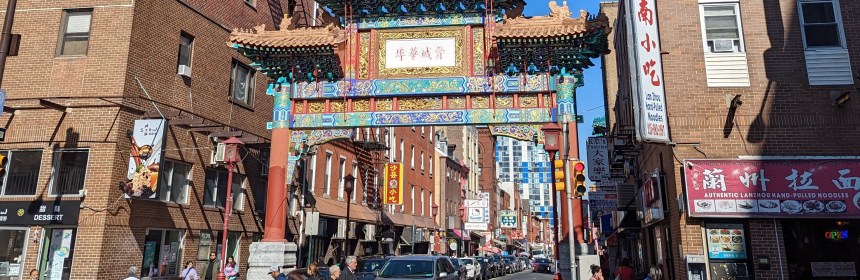
The first time that I worked directly with the Asian community in Philadelphia was when I volunteered as a Census trainer in Chinatown. In late 2019, the City of Philadelphia was recruiting multilingual trainers to ensure that everyone filled out the census, including immigrants and refugees. At that time, I gave a training presentation in Cantonese to about 100 older residents in Chinatown. To my surprise, they were very enthusiastic about filling out the census. Through this experience, I connected with the Philadelphia Chinatown Development Corporation (PCDC), my former employer. They asked me if I would be willing to lead a program that aims to promote mental health and wellness in the Chinese immigrant community because they just received a grant from the Scattergood Foundation. I said yes.
It is important to note that the model minority stereotype is powerful both outside and inside the Asian community. This stereotype falsely paints the picture that all Asians are doing well socially and economically, that we are the “model minority”, implying that Asians do not face any adverse experiences. Of course, it isn’t true. That said, it makes starting a mental health program, which encourages this community to talk about their problems, very challenging. I thought I needed to better understand how we could meet the community where they were at. So, when I first became the Founder and Program Director of the Chinese Immigrant Families Wellness Initiatives (CIFWI), one of my first tasks was to utilize my skills as a sociologist to survey respondents from the local Chinese communities. We asked them about their adverse childhood experiences and mental health needs because we recognize that a trauma-informed approach was necessary. The bilingual survey yielded 80 responses. The results presented some shocking findings. One of which being one in four said that they had experienced domestic abuse or sexual violence. We also found that there is a stark difference between the first generation and the second-generation immigrant Chinese. While first-generation immigrants reported employment and financial inclusion as major struggles in life, second-generation immigrants reported that racism and identity were the biggest issues. Learning from the survey results, it became very clear to me that our program must create different programs for various generations. We are proud that through CIFWI, we were able to provide wellness workshops and webinars for first-generation immigrants, parents, and older adults. We also created a youth program that served high-school and college students, creating a safe space for them to process their feelings and support each other.
In early 2021, I added to my work as the Project Manager for the COVID-19 Vaccine Equity Initiative. During the early rollout of the COVID-19 vaccine, the only way most Philadelphians could get the vaccine was in the Convention Center. Although it was only a few blocks away from Chinatown, barriers to access the vaccine prevented many senior residents in Chinatown from getting vaccinated. Even if they knew how to use a computer, they didn’t know how to fill out the form in English. So, PCDC partnered up with FEMA to notify Chinatown residents about any leftover vaccines, as vaccines not being used would be wasted. Our team escorted senior residents to get the vaccine and help them fill out the form on-site. Later, we were able to partner with a local pharmacy and operate a weekly vaccine clinic in the Crane Community Center in Chinatown. I am proud to say that we vaccinated close to 6,000 people in Philadelphia, and 95% of them had limited English proficiency. We also partnered with the Africa Cultural Alliance of North America (ACANA) to share critical resources with the African and Caribbean communities in Southwest Philadelphia.
What do you do now that you have transitioned to working with the City of Philadelphia?
My formal role is the Director of Racial Equity, Storytelling, and Community Impact in the Office of Community Empowerment and Opportunity (CEO). CEO serves as a funder, a convenor, and a collaborator to advance racial equity and promote economic mobility among vulnerable populations in Philadelphia. My day-to-day role involves thinking creatively about how CEO can integrate racial equity into our communications and operations. I work to change the hearts and minds of government workers, policymakers, and stakeholders to put racial equity at the center of the work. One can look at a statistic, but to motivate stakeholders to take actions, we must replace harmful narratives with antiracist and powerful narratives by telling a series of compelling stories. We also need to recognize the value of lived experience as knowledge. As such, we must actively listen to community members about what their needs are. It is through equitable community engagement that we can obtain real stories and understand emergent needs from the community, something I don’t get by simply sitting behind the computer screen.
How has your background in sociology helped you with this work?
My background in sociology is the main reason why I can bring a fresh perspective to my current work. In the public sector, there are many talented individuals who have specialized skills and knowledge. For example, in the policy world, there is much knowledge in laws and policies, and people possess skills and understanding of structures and systems to bring the right people to the table to advocate for and advance equity. In the non-profit world, on the other hand, there are many passionate folks working on the ground, alongside community members and social agents. Sociology is the magic glue that connects structure with agency. I think the push and pull between structure and agency is a relatively new perspective in a lot of the circles I enter.
What do sociologists misunderstand about this kind of work?
I really wish that there would be more sociologists working in the public sector. I think sociologists can bring such a valuable perspective, serving as the glue of other disciplines. I’m not sure why, but in my experience, working for the government or non-profit institutions isn’t often being encouraged when I was a graduate student. There seems to be a stronger focus on developing critical understanding about social issues and policy without much consideration for pragmatism. Making change in the “real world” requires a lot of partnership, collaboration, and compromises. You’ve got to be able to walk into the room and know that you are not going to be right because that is not the point. The point is how do we gather available resources and make the best out of many imperfect situations. As sociologists, we pride ourselves on employing a critical lens to understand social processes—I get it—but that is not always helpful in the real world. I guess if sociologists can quiet our egos, listen more, and think harder about how we can contribute with our sociological perspectives, we can truly bring so much value to the world. Our perspective is valuable and unique, but it is not complete. We hope more sociologists will be sitting on tables making important policy decisions. To do so, we all need to step out of our comfort zone a bit. It’s not always about forming a critique.
What do you think sociology has to offer to this work?
Sociology has a strong focus on the social, cultural, and political. Right now, in Philadelphia, for example, we are seeing community opposition against the proposed 76ers arena. Community groups from Chinatown and elsewhere are pushing for an environmental impact report. The goal is to illuminate potential impacts that the arena would have on communities like Chinatown and the city as a whole. Being an urban sociologist, I know for a fact that there is a lot of literature that discusses the negative impacts that large-scale developments like sports stadiums have on local communities. Sociologists are good at developing case studies, studying about what happened, but I’m not sure how we are using these case studies in ways that help inform future policies and equitable development. Economists can estimate economic costs and impacts. Urban planners can tell us more about transportation and parking. But what about human costs and cultural values? Sociologists can bring that unique perspective to the table.
 Community and Urban Sociology