
City Spotlight Chicago: Don’t Go
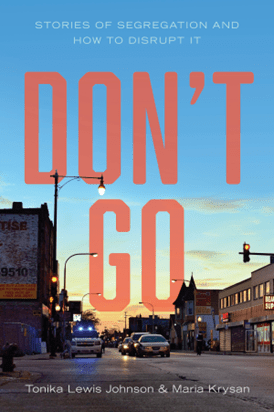
Images and excerpts reprinted with permission from Polity Press.
Maria Krysan, University of Illinois Chicago
Have you ever been told “Don’t Go” to Chicago’s south or west sides? And/or that they are dangerous?
I have.
I moved to Chicago in 2000 to take an assistant professor job at the University of Illinois Chicago. It was the tightest rental market in recent memory, so rentals were expensive and hard to find, and I only had a weekend. After a failed attempt to find an apartment in the city, I went to the only logical next place if you are a student of residential segregation: Oak Park, a village on the western border of Chicago, famous among sociologists for its intentional pursuit of an integrated community in the midst of a notoriously segregated city (see The Oak Park Strategy by Carole Goodwin for an early history).
I settled into an apartment in Oak Park and soon learned that lots of UIC faculty lived in Oak Park. Probably in part because you can get on “290” (the Interstate) and get off a handful of exits later right at UIC’s campus (depending on traffic, 8 minutes or 80 minutes later). Within a few weeks of my arrival on campus, one of my new colleagues (long since retired), warned me to never get off the interstate on my 7-mile commute. “It’s not safe. It is way too dangerous. No, seriously. Just don’t do it.”
Well, I did it all the time. And nothing happened. When I drove through the West Side of Chicago, what did happen was that I avoided the claustrophobic sensation of interstate “stop and go” (mostly stop) traffic, saw gorgeous classic architectural housing styles (Historic Bungalows, Greystones, etc.), and regularly passed by a Fred Hampton mural (which led my daughter and I to learn more about the story of this Black Panther leader).
But I digress.
My hunch is that your answer to my question is also a yes, and that you have heard or been told Don’t Go. And you may not have stopped and thought about how that mindlessly dispensed advice helps perpetuate segregation. To over-simplify: there are places people are told not to go. These places have been systematically disinvested in. And mostly, these are places where Black and Brown people predominate. And the advice means people, and businesses, don’t go. They don’t invest. The cycle continues.
The Social Justice artist and lifelong resident of Chicago’s South Side neighborhood of Englewood, Tonika Lewis Johnson, created the acclaimed project, Folded Map, to draw attention to, and seed conversations about, Chicago’s segregation. Folded Map is a multi-media representation of Chicago’s segregation that takes advantage of Chicago’s grid structure. Because it’s on a grid, Paulina Avenue, for example, goes from all the way south to all the way north. So, if you “fold the map” at Madison Avenue (Chicago’s midpoint), the residents of 6300 N. Paulina Avenue and those at 6300 S. Paulina “touch” –Tonika calls them Map Twins—but they live in profoundly different social environments, thanks to segregation and the inequities it perpetuates.
Journalists indirectly introduced me to Tonika in 2018 and I have been honored to collaborate with her on several of her Folded Map extensions—action kits, curriculum, and, most recently, a book. Don’t Go: Stories of Segregation and How to Disrupt It (Polity Press 2025) is described by Henry Louis Gates, Jr. as “A powerful reminder that segregation isn’t just points on a map; it’s about the geography of feelings inside those growing up within it’s shadows.” And Sociologist Lawrence Bobo points out that “The human voices and engaging, innovative approach do more than a mountain of data ever could to bridge racial barriers.”
The book includes the origin story of how Tonika first began thinking about the power of the Don’t Go narrative as an engine of segregation. During her many Folded Map presentations, she started to ask: “raise your hand if you’ve ever been told not to go to…”. Regardless of the size (50 to 500) or configuration (lifelong residents or transplants; students or CEOs) of the audience, the result was the same. Every hand went up.
She posted a video of one of those presentations—which happened to be to first year Northwestern University students. It went low-key viral on Instagram @tonikaj where Mary Schmich, a Pulitzer prize-winning columnist saw it, interviewed her, and wrote a column in the Chicago Tribune about it. When Tonika posted the column on IG, she asked followers to share their own Don’t Go stories. And they did. More than 70 in a few weeks’ time. To make a long story short, Tonika and I ended up interviewing 29 of the people who emailed their stories, and published five stories in the hyperlocal news source, Block Club Chicago. The positive response encouraged us to write a book. So, we did. Don’t Go is a collection of stories of everyday people who have either been told Don’t Go to Chicago’s South and/or West Sides, or who live in the neighborhoods people have been told not to go to. The book is an accessible (think photos, short stories, and non-jargon reflections) and optimistic conversation-starter (great for teaching!) whose goal is to shine a spotlight on this often-repeated and damaging advice. It is an invitation to unpack the historical and sociological explanations for why a community has been labeled a Don’t Go zone. And it is optimistic because it includes stories that can inspire readers to re-consider what they think they know and imagine how they might help disrupt the narrative in their own lives.
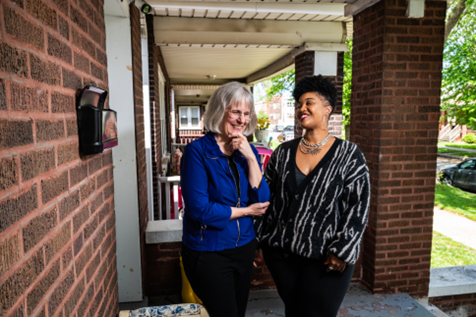
Photo credit: Colin Boyle
Three excerpts from Don’t Go
Maria’s note: To give a feel for the book, I am sharing edited excerpts from 3 of the books’ 25 stories. After reading them, you might get the incorrect impression that it’s a book full of sociologist storytellers (2 of the 3 excerpted storytellers happen to have degrees in sociology). Although several of our storytellers did mention formative experiences in sociology classes, these are the only two with degrees.
Indeed, one of the things we are most proud of in the book is the variety of people whose stories are included—young, middle-aged, older-aged; Black, White, Latino, Asian; lifelong Chicagoans to recent transplants. And our storytellers do a lot of different things—AirBnB host, boutique owner, engineer, social worker, activist, piano repairman, artist, non-profit staff, urban planner, and on and on. Most importantly, all are everyday people who took a chance on sharing their stories of disrupting segregation with a Black artist and a White academic.
Find the book at your favorite independent bookseller and directly from Polity Press. You can also stop by Polity Press’ booth at the ASA Exhibit Hall in Chicago to take a look and receive a discount code.
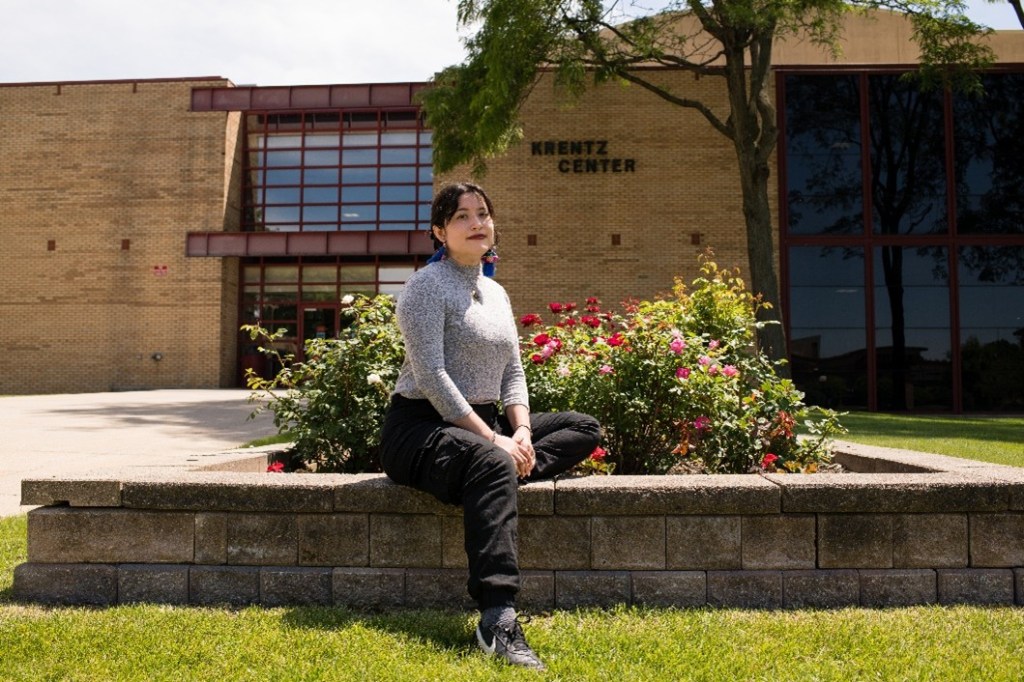
Leslie (the Sociology major)
Maria’s note: “When I started studying segregation from the perspective of perceptions of communities, I was focused on how these perceptions impact people’s housing decisions and our economic and housing policies. But Leslie’s story asks us to think more deeply about how people feel when they’re cast as the embodiment of that misperceived community” (p. 267).
When I got to Concordia University Chicago in 2012, I was like, oh my goodness. I’m here. I’m in college. This is unreal to me…. [At college orientation], I mingled with a group of other Latinx students from the North Side. We had never met. And as soon as I said that I grew up in Humboldt Park, and that I lived now in Cicero, I was categorized as an outsider, as a dangerous person from “the ‘hood” (p. 203-4).
I didn’t know this at the time, but my address told people how they should talk to me, about me, and at me. … Another layer is added on if you talk about what schools you come from; I was looked at like a wild child for coming from Chicago Public Schools (CPS) instead of a private or charter school. They were so surprised to learn that I had aced my math placement – because it complicated what they thought they knew about CPS and the West Side (p. 204).
I just want to ask people, “Do you really want to know about me, or do you want to just confirm what you’ve been told about people like me?” (p. 207).
Jerry (the PhD student in Sociology)
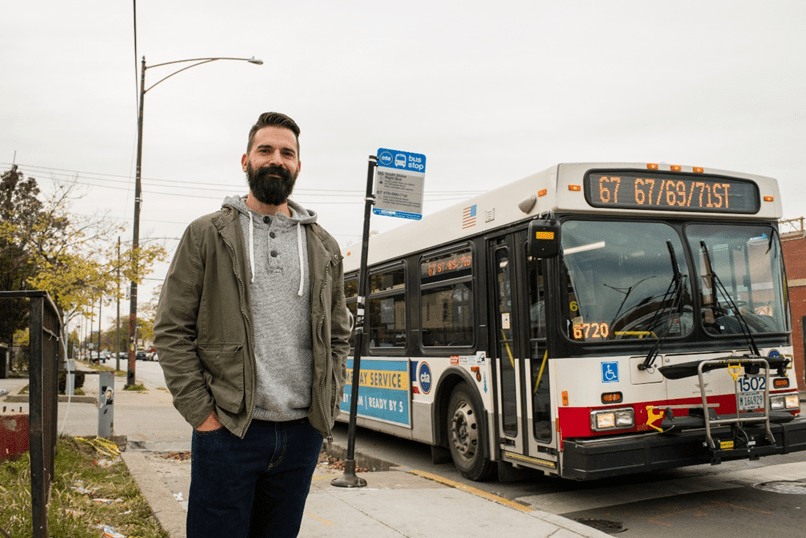
Maria’s note: When deciding who to interview among the 70+ people who emailed us stories, I’ll be honest: the one sociology PhD student at the University of Chicago kept falling to the bottom of the pile. I was biased. I figured I pretty much knew what he would say. Fortunately, our need for more gender diversity led us to invite Jerry to participate. We are so glad we did.
I distinctly remember … going to Englewood on the bus for the first time … I had a strong sense that I was this White dude on this bus of all Black people. I had to get off the bus and stand at an intersection waiting for the next bus … You’re not so worried about something happening to you on a bus, but a White dude standing on an intersection? I remember being like “Okay, when they say stuff happens, this is where it goes down. This is it. This is where it happens. Text momma and tell her you love her” (p. 54-5).
[But] it turns out it’s really uneventful … Eventually, I realized that the people on the bus weren’t focused on me. They don’t care. Part of Whiteness seems to be that you think everybody gives a damn. Like you think that when you’re in these spaces, Black folks can’t help but be like, “Oh, who is this guy? I wonder why he’s here.” But Black people have their own lives. They don’t care why you’re there. And they certainly don’t care about you waiting for a bus. They don’t care about you sitting on a bus. Seriously, you could write a Dr. Suess book about this (p. 55).
…[W]hen I started my PhD program at the University of Chicago, I received clear messages from my peers: “Don’t go past the Midway! Be careful. Don’t leave Hyde Park. The South Side is dangerous!” So I decided to take that bus ride down to Englewood and see for myself. I just wanted to commit to trying to see what these spaces were like. And a little bit of me thought as a sociologist, “Will I really put my money where my mouth is? Am I gonna do this, or not?” (p. 59).
He went on to say:
So I think we need to get into that kind of space and feel all the uncomfortableness and whatever. And to be really honest, I felt some shame. That even as an academic who’d been studying this stuff. I too was fearing things. I know I shouldn’t be afraid, but I guess this is just part of the process. Apparently, just reading books doesn’t change everything (p. 55-6).
Tiana (the Englewood Engineer)
Maria’s note: Tonika regularly points to Tiana’s story as one that she resonates with a lot. Both she and Tiana were born and raised in Englewood, and shared so many of the joys of growing up on the South Side but also the pain of people’s misperceptions and stereotypes. And both are fierce defenders of the South Side.
I was born and raised in Englewood. … I had my choice of colleges that accepted me, but my Uncle Elliot always told me IIT was the place to go for engineering. … [Growing up], I never saw anyone that looked like me at IIT when I walked around it. So I vowed to maybe be the one person that somebody might see and say “…I see someone there who is just like me. I can go to IIT too”. Maybe I can be what I was looking for (p. 209-10).
On my first day as a student there in 2000, I remember thinking, “Any ethnicities that you can think of are here!” I was excited to learn about new cultures. … [At] a parent orientation event… my mom and I were shocked (to say the very least) when the presenters told the whole auditorium of mostly White and International students that it is NOT safe to ride the Red Line. And don’t go east of Michigan Avenue, north of 31st street, south of 35th street or west of the Dan Ryan Expressway (p. 210-11).
My mom was just disgusted. The people on stage at the orientation basically told a room full of newcomers to Chicago not to go to our neighborhoods because it was unsafe (p. 212).

Learn More and Do More
If you are interested in learning more, you can read the original five stories published in 2021 by Block Club Chicago, and then check out the news coverage when the book was launched in 2025 in another Block Club Chicago article, a WTTW (Public TV station) news story, this WBEZ (NPR affiliate) story, or at our book’s website.
And think twice about how you approach your stay in Chicago in August. And how you talk about the places you go and don’t go. Maybe even challenge yourself to push back against the narrative and find some places to go on the South and/or West side. And spend your money there.
You might be thinking, “tell me where to go.” Since there are too many possible destinations to list here, I’ll start with three of the venues where we had launch events for our Don’t Go book earlier this year:
- Bronzeville Winery
- Diversey House (not on the South Side, but a fascinating collab between Northsiders and Southsiders—check the story at Block Club Chicago),
- The Silver Room
Or take a tour with Chicago’s favorite social media historian, Dilla. Or follow him on Instagram @6figga_dilla. As Dilla says, “Everything dope about America comes from Chicago”. So, when you visit Chicago this August, make an effort to visit all of Chicago.
 Community and Urban Sociology