Tag Archives: interview

Interview with Kiara Wyndham-Douds, 2022 Graduate Student Paper Award Winner

Kiara Wyndham-Douds, an Assistant Professor of Sociology at Washington University in St. Louis, was the winner of the 2022 Graduate Student Paper Award. Kiara’s innovative research agenda examines mechanisms that create and sustain racial inequality in contemporary American society. Their current research focuses on the intertwined nature of race and space to investigate the spatial production of racial inequality in suburbs. We reached out to ask them to discuss their research, and we’re including their responses below. Thanks to Kiara for participating in our interview series!

What were the main findings of your paper?

My paper – “The Diversity Contract: Constructing Racial Harmony in a Diverse American Suburb” – examines the dominant racial ideology in a highly racially diverse and affluent suburb of Houston, Texas, called Fort Bend. I conducted 109 in-depth interviews with residents and community leaders and found that, rather than adhering to colorblindness, the dominant racial ideology identified in other settings, residents adhered to what I call the diversity contract, a local racial ideology. Key elements of the diversity contract include the belief that the community is racially harmonious and has no racial inequality. Residents also contend that the community is racially exceptional and morally superior to other places. Though seemingly race conscious, the diversity contract ultimately functions to obscure racial inequality and uphold white domination.

Read more

Interview with Xuefei Ren, Co-Winner of the 2022 Robert E. Park Book Award

Xuefei Ren (Michigan State University) was the co-winner of the 2022 Robert E. Park Book Award for her book, Governing the Urban in China and India: Land Grabs, Slum Clearance, and the War on Air Pollution. CUSS publication team member Kyle Galindez reached out to Xuefei to discuss the genesis of her book and what is next for her research agenda.

What motivated you to study this research topic? 

My first two books—Building Globalization: Transnational Architecture Production in Urban China (University Chicago Press, 2011) and Urban China (Polity Press, 2013) focused only on Chinese cities only. While working on these projects, I began questioning whether China’s urban experience is as exceptional as specialists often argue. I decided to incorporate a comparative perspective into my work and turned my attention to the urban experience of another enormous, developing country—India.

What were the main findings of your research?

My book challenged two prevalent views on urban governance in China and India. The first is the state-capacity perspective—the view that China’s urban governance is defined by powerful local governments, and India’s by fragmented local authorities. The second concerns regime types—the view that the key differences in urban governance in the two countries can be explained by a country being authoritarian or democratic. I critique these views as reductive and propose an alternative thesis. 

I argue that urban governance in China is territorial in nature as it is anchored on territorial institutions; urban governance in India, by contrast, is associational because it is based on alliance building. The reasons for these disparate approaches, I conclude, are rooted in each country’s historical and institutional development in the longue durée

Post-reform China inherited from previous eras a set of strong territorial institutions (such as the hukou system and dual-track land ownership) and introduced new territorial policies (such as Special Economic Zones) to spearhead urban development. India, lacking strong territorial institutions, bases its urban governance on associational politics, as actors from the state, the private sector, and civil society form contingent alliances to promote policies and projects.

What surprises did you find as you conducted your fieldwork/study?

At the theoretical level, the territorial logic of Chinese urban governance is a surprising insight. It is rarely discussed in urban China studies, which tend to focus on the local state capacity only. It’s an insight that came out of the comparison. 

On the policy level, I was surprised by the imbalance in information and knowledge among Chinese and Indian policy makers. Many Chinese officials and business people simply don’t know much about India. When Chinese officials take international “study tours,” most of them choose to visit the U.S. and Europe. If they knew more about India, they would find many points of comparison to be illuminating and meaningful. On the other hand, Indian policymakers and business leaders know a lot about China. They are very aware of the pitfalls of the Chinese model of development—high levels of inequality, over-investment in infrastructure, unsustainable land-based municipal financing, dominance of state capital, and the large rural-urban divide.

How do you plan to build on this work in the future?

As a University of Chicago-trained urban sociologist who has been studying cities in the developing world, I want to connect the fields of American urban sociology and global urban studies. Building on my research on China and India, I have extended my comparative work to North American and European cities. I’m working on a project about the “global rustbelt”, examining culture-led revitalization in Detroit, Harbin (China) and Turin (Italy). I’m also working on a new project related to the pandemic, with colleagues in Canada and South Africa. We want to study how Chicago, Toronto and Johannesburg differently responded to the pandemic and how the pandemic has affected the most vulnerable neighborhoods in these three cities. 

Interview w/ Junia Howell and Elizabeth Korver-Glenn

The 2022 Jane Addams Article Award was presented to Junia Howell (University of Illinois Chicago) and Elizabeth Korver-Glenn (Washington University in St. Louis) for their 2021  Social Problems article entitled “The Increasing Effect of Neighborhood Racial Composition on Housing Values, 1980–2015.” Drawing on decades of data from the U.S. Census, their analysis demonstrates that neighborhood racial composition is a stronger determinant of appraised housing values in 2015 than it was in 1980. Thalia Tom reached out to Junia and Elizabeth to discuss their research, and we’ve included Junia’s responses below. Thanks for participating in our interview series!

Read more

Interview w/ Addams Award Winners Josh Pacewicz and John N. Robinson III

The 2021 Jane Addams Article Award was awarded to Josh Pacewicz and John N. Robinson III for their article “Pocketbook Policing: How Race Shapes Municipal Reliance on Punitive Fines and Fees in the Chicago Suburbs.” Published in Socio-Economic Review in 2021, this article draws on both quantitative and qualitative methods to show how municipal reliance on fines and fees varies across race and class lines in the Chicago suburbs. Josh Pacewicz is Associate Professor of Sociology at Brown University, John N. Robinson III is Assistant Professor of Sociology at Princeton University. Andrew Messamore and Benny Witkovsky reached out to John and Josh to discuss their article and an abridged version of that discussion is below. Thanks to John and Josh for participating in our interview series!

Let’s start by talking about this paper. What did you seek to find? What did you ultimately find?

Robinson: We originally wanted to take an exploratory look at the problem of fines and fees, which had become a big topic of dialogue in the aftermath of Ferguson. Once we got into the data, we saw that these monetary punishments were concentrated in many Black suburbs, and especially relatively affluent ones. For context, the financial penalties that we found in these communities (mostly traffic fines, but also things like fines for overgrown weeds) differed from those we would find in much poorer areas (see, for example, Alexes Harris’ pathbreaking work, which focuses on the penalties associated with criminal prosecution). The racialized effect of fines and fees in the lives of poor households and communities is more dramatic and impactful over the long-term. But our findings on these relatively affluent Black areas show that these communities are in some ways more like poorer Black communities than their affluent white counterparts. Importantly, we also found that the places dealing with these penalties also suffered a range of other issues that white affluent communities didn’t, including exorbitantly high property taxes, exploitative tax incentive schemes, deficient public services, etc.

Read more

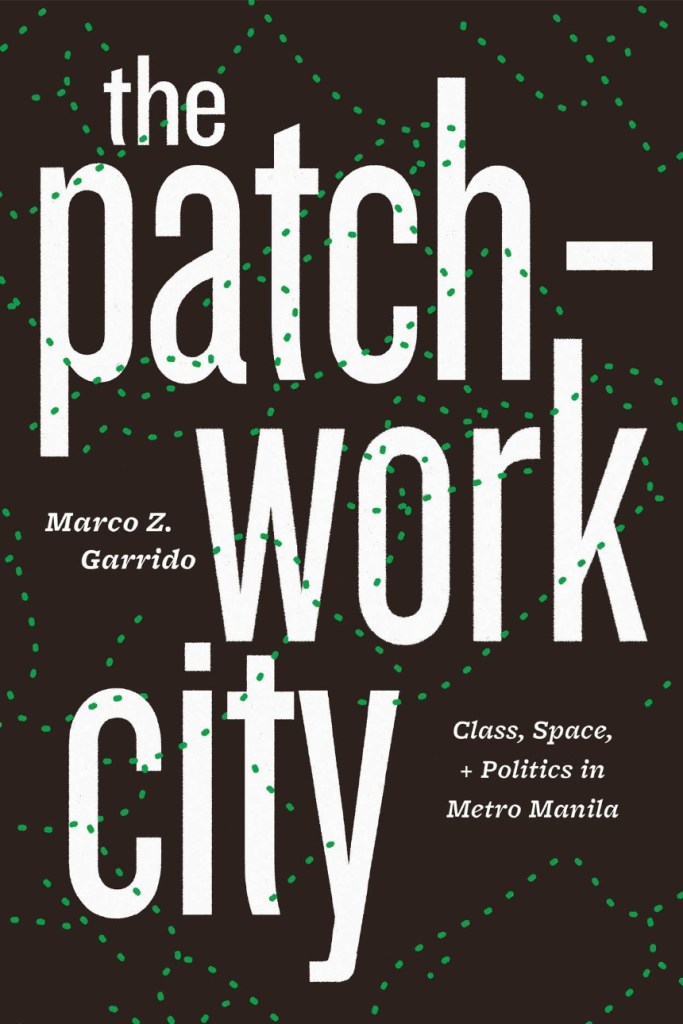
Interview w/ Marco Garrido winner of 2021 CUSS Book Award

Kyle Galindez interviews Marco Z. Garrido author The Patchwork City: Class, Space, and Politics in Metro Manila (University of Chicago Press 2019).

What were the main findings of your research?

The book’s argument is that the spatial transformation of Manila is worsening class relations and widening the political divide. Specifically, I document the proliferation of poor and upper-class areas—slums and enclaves—across the city and their sharper segregation. I then describe the fraught relations between the residents of these places and argue that segregation—specifically, their proximity to one another—has made their relations worse. Slum residents more frequently experience discrimination, while enclave residents feel insecure about the presence of squatters nearby. I then consider the political views of each group, particularly with respect to the populist president Joseph Estrada. Not only do they tend to see Estrada in polar opposite ways, but their views are substantially informed by their feelings of discrimination and insecurity—that is, by their class positions. Broadly speaking, the books’ argument represents an effort to connect space, class, and politics, or rather, to show how these domains are more continuous than we like to think. Indeed, we should think about them together, as bound up in the same processes. And so while The Patchwork City is a work of urban sociology, it is also, equally, a work of political sociology. It adopts a view of social class as taking shape through spatial segregation (as well as shaping it, of course), and of political subjectivity as being shaped by class relations. Thus, as the city is transformed by global processes, so are social relations and contentious politics.

Read more

Interview w/ George Greenidge Publicly Engaged Scholar Award Winner

CUSS Newsletter, Winter 2022, Vol. 35, No. 1

George (Chip) Greenidge, Jr., a Ph.D. Candidate at Georgia State University, was the winner of the 2021 Publicly Engaged Scholar Award. George is a scholar-activist whose commitments span non-profit work, government service, philanthropy, and education. Recently, he was President of the Boston Empowerment Zone, a federally funded HUD initiative aimed at economic investment in U.S. urban neighborhoods, and the Founder and Executive Director of the National Black College Alliance, Inc., a nonprofit focused on providing alumni mentors to college and high school students. Currently, George is also the Founder and Director of the Greatest MINDS, an organization which aims to promote public discourse, citizenship and inclusive democracy. He is also a Visiting Democracy Fellow at the Ash Center for Democratic Governance and Innovation at Harvard Kennedy School.  Benny Witkovsky and Andrew Messamore reached out to George to discuss his career. Thanks to George for agreeing to participate in our interview! 

Read more

Interview w/ Stefanie A. DeLuca

CUSS Newsletter, Winter 2022, Vol. 35, No. 1

Stefanie A. DeLuca, James Coleman Professor of Sociology and Social Policy at Johns Hopkins University, is one of 2021’s Publicly Engaged Scholar awardees. Over the course of her career, Stefanie has worked closely with local, state, and federal policymakers to enact meaningful change in the domains of housing accessibility and racial desegregation. Her dedication to publicly-engaged research is reflected in her service to several HUD federal housing commissions in addition to local community and non-profit agencies. More broadly, Stefanie’s scholarship has positively impacted countless households by shaping federal legislation on housing vouchers as well as local housing mobility programs across the country. Thalia Tom reached out to her to discuss her research, and we’re including her responses below. Thanks to Stefanie for participating in our interview series!

Read more

Interview w/ Jackelyn Hwang: 2020 Addams Award for Best Article

Jackelyn Hwang, an Assistant Professor of Sociology at Stanford University, was the winner of the 2020 Jane Addams Award for best article. Jackelyn’s innovative research agenda examines the relationship between how neighborhoods change and the persistence of neighborhood inequality by race and class in US cities. We reached out to ask her to discuss her research, and we’re including her responses below. Thanks to Jackelyn for participating in our interview series!

Read more

2020 Park Award: Sites Unseen

The winner of the 2020 Robert E. Park Award is Sites Unseen: Uncovering Hidden Hazards in American Cities.  New York: Russell Sage Foundation by Scott Frickel  & James R. Elliott. It is part of the American Sociological Association’s Rose Series in Sociology. Below is a discussion with the winners on industrial waste and its legacy in the urban landscape.

Read more

Interview w/ H. Jacob Carlson – 2020 Graduate Student Paper Award Winner

2021 Winter, Vol. 34, No.1 

H. Jacob Carlson, a postdoctoral scholar at the Population Studies and Training Center at Brown University, was the winner of the 2020 Graduate Student Paper Award. Jake’s innovative research agenda leverages the urban and political sociological traditions to address new questions about democracy, housing, and changing cities. We reached out to ask him to discuss his research, and we’re including his responses below. Thanks to Jake for participating in our interview series!

Read more
« Older Entries Recent Entries »